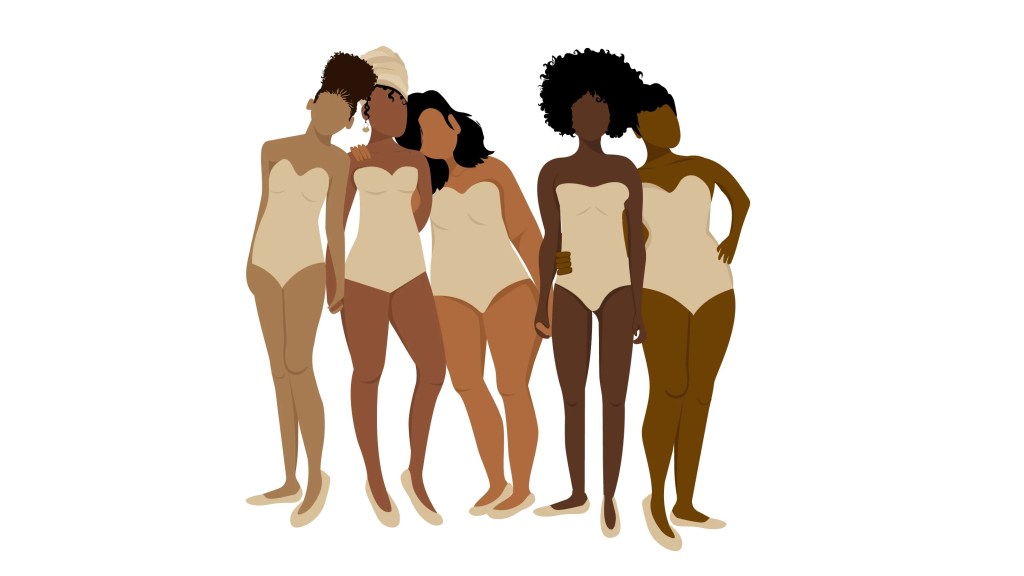
In American media, there are countless films and television shows that promote and reinforce negative stereotypes. For Black people, in particular, there is a stronger presence of these harmful ideas throughout various media texts. One major area of concern is the visual representation of Black people, specifically the inaccurate portrayal of their bodies. As a result, media audiences, both Black and non-Black, consciously and subconsciously treat Black people according to what is presented in the media. These ideas and stereotypes disproportionately affect both Black men and women in their daily lives. The portrayal of Black men as either muscular or obese and Black women as either thin or overweight harms Black people–individually and collectively–by influencing the way individuals perceive and interact with them.
Black male bodies are often overly muscular in the media to represent hypermasculinity. In Tough Guise: Violence, Media, and the Crisis in Masculinity, Jackson Katz defines masculinity as a performance learned from and reinforced by the media (Tough Guise 55:00-55:47*). In various media texts, Black men are depicted as having a bulky figure with huge muscles, strong legs, and possibly even abs. “Representations of black men in American film so often rely upon a particularly overdetermined image of black masculinity–an image now widely on display in American culture” (Henry 119). It is typical for them to be shown flexing and partially clothed–without a shirt–to show off and emphasize their physical appearance. Oftentimes, this leads to muscular black men being sexualized and fetishized. These Black men are almost always tall or at least perceived to be tall as a way to accentuate their natural dominance. For instance, in The Green Mile, when viewers are first introduced to John Coffey, they see the White officers’ faces and reactions before they actually see what Coffey looks like (The Green Mile 12:35-14:25). The scene was intentionally shot in a way to emphasize his muscular build in comparison to the white officers. Through their interactions, the officers seemed surprised by his lack of aggression, which shows that they stereotyped him based on his appearance and race. Sometimes, this portrayal of extreme masculinity leads to Black men being described as confident or powerful. Majority of the time, however, this portrayal leads to them being labeled as dominant, aggressive, and violent in the real world. Steven Spielburg’s The Color Purple, for example, viewers disliked that “Black men [were] portrayed unnecessarily as harsh and brutal (Bobo). The presence of flawed representations of Black male bodies affect the way non-Black media consumers interact with Black men. Because non-Black media consumers may expect and assume that all Black men are dangerous, they may create a false narrative about Black men being overly assertive, forceful, and confrontational. As a result, non-Black media consumers tend to be more hesitant around them or not take time out of their days to greet and get to know them. A White woman, for example, may clutch her purse when walking near a Black man, or she may cross the street to avoid walking next to or past a Black man on the sidewalk.
Conversely, Black male bodies are also depicted as obese in the media to portray laziness and uselessness. They tend to be very sloppy and have big bellies, similar to a dad bod. Black male bodies that are not brawny–such as obese bodies–are ostracized in the media. They are depicted as inferior to other Black, mostly muscular, men. Characteristics to describe these men are lazy, uneducated, and poor. Although Michael Oher from the 2009 film The Blind Side has a bigger body type, he did not fall subject to exclusion since he served as a source of entertainment by playing football (The Blind Side). Contrary to muscular black male bodies, obese black men are desexualized and rarely seen showing off their physiques. On the rare occasion that they are unclothed, it usually serves to humor the audience as a form of comedic relief or emphasize their sexual inexperience. While black male body types differ in the media, these representations all negatively influence the way black men are interpreted and accepted in the real world. The portrayal Black male bodies as sloppy and obese leads to self-esteem and confidence issues among Black men because society may expect them to behave or speak a certain way. There is little to no room for them to truly be themselves when they are constantly being portrayed as hypermasculine. Black men who do not conform to this type of masculinity are labeled as lacking basic male attributes in society. The thought of not being man enough or being too feminine causes Black men with less than ideal bodies to be ashamed of themselves. Non-Black media consumers may begin making conclusions about all Black men who stray away from the ideal body type of muscularity. They may assume that obese Black men are lazy, incompetent, and responsible for their build due to the dominant ideologies present in Americann media. As a result, non-Black media consumers are taught to expect much less from this group of Black men, which contributes to the way they are treated in their daily lives. This is problematic for obese Black men because it prevents them from being given the same opportunities as other Black men since they are deemed incapable and therefore, useless.
Additionally, Black female bodies are represented in the nude to symbolize hypersexualization and attractiveness. In the media, these Black women are usually wearing revealing clothing, specifically with either their bosom or bottom showing. “Even when representations of Black women [are] present in film, our bodies and being [are] there to serve” (hooks 310). This can be explained by the male gaze, which occurs when filmmakers create a media text with the idea that heterosexual men are the dominant, intended audience. These women tend to be highly attractive, skinny or slim and mostly tall to enhance their appearance and features. It is also common for them to be young and portrayed as vulnerable, sensitive, and submissive, especially when it comes to sexual activities. Media theorist Stuart Hall argues that the media appear to reflect reality, but in fact, they create it” (Shutt 2). The representation and display of naked Black women in the media with thin or slim figures promotes the idea that they are sexually promiscuous or provocative and want to be sexualized. As a result, Black media consumers conclude that Black women with “nice” figures must be hit on and objectified. In Byron Hurt’s Hip Hop: Beyond Beats and Rhymes, Black men openly touch Black womens’ bodies in public due to the way they are depicted in the media, specifically rap music videos (Hip Hop 29:40-30:20). When these women reject or dismiss men who catcall them or try to get their attention, they are called derogatory terms like slut or bitch. In some cases, they may even be sexually assaulted or harrassed. A common misconception is that Black women wear certain revealing or scandalous clothing for the purpose of getting a man’s attention. However, in reality, many times black women portray themselves in this manner as a form of empowerment. Musical artists such as Megan Thee Stallion and Madonna are well-known examples of women that wear revealing clothing to empower themselves and others.
Likewise, Black female bodies are portrayed as overweight and heavyset in the media to portray manliness and lack of femininity. In American media, Black women with this body type possess chubby faces, large arms, and thick legs. Typically, they have darker skin tones, for it is rare to see lighter skin Black women in the media possessing the above features. This visual representation implies that heavier Black women are unhealthy, ugly, and manly. Overweight Black women are masculinized by American media drawing comparison between them and overweight Black men. In Set It Off, a film about four Black women who rob a bank, Queen Latifah embodies traditional masculinity. She explains that her character, Cleo Sims, is “a straight-up dyke … men’s drawers, the whole nine” (Zook 72). Contrary to Black women with thin figures, heavyset women are often shown wearing unflattering clothing, which drives viewers to desexualize them and regard them as undesirable. In the 1993 sitcom Living Single, Queen Latifah’s character, Khadijah James, exemplifies this stereotype through her appearance and behavior (Living Single). Compared to the other three Black female characters, Khadijah is thicker and has a stronger, deeper voice, which contributes to her desexualization by viewers. This desexualization often leads to them being lonely despite desperate attempts to find companionship. “Critical Black female spectatorship emerges as a site of resistance only when individual Black women actively resist the imposition of dominant ways of knowing and looking” (hooks 103). Pop star Lizzo, for example, presents herself as a counterexample to this outdated view of Black women with bigger bodies. Her rise in popularity can be credited to talent, beauty, confidence, and body positivity.
American audiences are comfortable with these poisonous images of Black male and female bodies in the media they consume because it allows them to put Black people and their bodies into specific categories. In American media, Black bodies are represented as extreme cases: Black men are either very muscular or very obese whereas Black women are either very thin or very overweight. Categorizing Black people in this manner simplifies complexities by making it easier for audiences, particularly White audiences, to put them into distinct boxes. As a result, American audiences believe that they have, therefore, gained a better understanding of how Black men and women speak, behave, and interact with other Black people and non-Black people. When a Black person deviates from their representation in American media texts, they are labeled as usual in comparison to their racial groups’ stereotyped body type. Since American media serves primarily as a form of entertainment for people, for the most part, audiences are not concerned with analyzing media beyond the obvious. Many audiences view and consume different films and television shows based solely on the actors and actresses that are present in these media texts. Audiences pay less attention to the negative stereotypes and tropes in media texts and more attention to the individuals behind the characters. Additionally, audiences are already familiar with these negative physical representations of Black bodies as a result of filmmakers continuously including them in the media they create. Therefore, for audiences that do not view the media with the intention of examining it and reading between the lines, it becomes more difficult for them to identify harmful representations of Black bodies.
The false visual representation of Black men and Black women throughout American media negatively influences the way they view themselves and the way they are viewed by society. When consumers view media texts and see Black bodies portrayed as muscular, overweight, or naked, they make an assumption about the entire Black population. As time goes on, these damaging portrayals may remain widespread in American media. However, in order to combat the beliefs and expectations that Black and non-Black individuals have about Black people and their bodies, there must be intentional change in not only filmmakers’ decisions but also consumers’ decisions. Representation of a wide range of Black bodies is essential for the progression of American media.
References
Bobo, Jacqueline. “Black Women’s Responses to The Color Purple.” Jump Cut: A Review of Contemporary Media, Feb. 1988, http://www.ejumpcut.org/archive/onlinessays/JC33folder/ClPurpleBobo.html.
Darabont, Frank. The Green Mile. Warner Bros., 1999.
Hancock, John Lee. The Blind Side. Warner Bros., 2009.
Henry, Matthew. “He Is a ‘Bad Mother*$%@!#’: ‘Shaft’ and Contemporary Black Masculinity.” African American Review, vol. 38, no. 1, 2004, pp. 119–26. JSTOR, https://doi.org/10.2307/1512235.
hooks, bell. “The Oppositional Gaze: Black female spectators.” The Feminism and Visual Culture Reader, edited by Amelia Jones, Routledge, 2003, pp. 94-105.
Hurt, Byron et al. Hip Hop: Beyond Beats & Rhymes. Kanopy Streaming, 2016.
Jhally, Sut et al. directors. Tough Guise : Violence Media and the Crisis in Masculinity. Media Education Foundation 1999.
“Judging by the Cover.” Living Single, created by Yvette Lee Bowser, season 1, episode 1, SisterLee Productions, 1993.
Shutt, Lisa. “Media Text and PrimarySecondary Document Notes.” Black Femininities and Masculinities in the US Media, University of Virginia. Received 31 August 2022. Professor notes.
Zook, Kristal Brent. “Living Single and the “Fight for Mr. Right”: Latifah Don’t Play.” Color by Fox: The Fox Network and the Revolution in Black Television, 1999, pp 65-74.
This was originally created as part of a class assignment for Black Femininities and Masculinities in the U.S. Media at the University of Virginia.
 Destiny Rae Jones