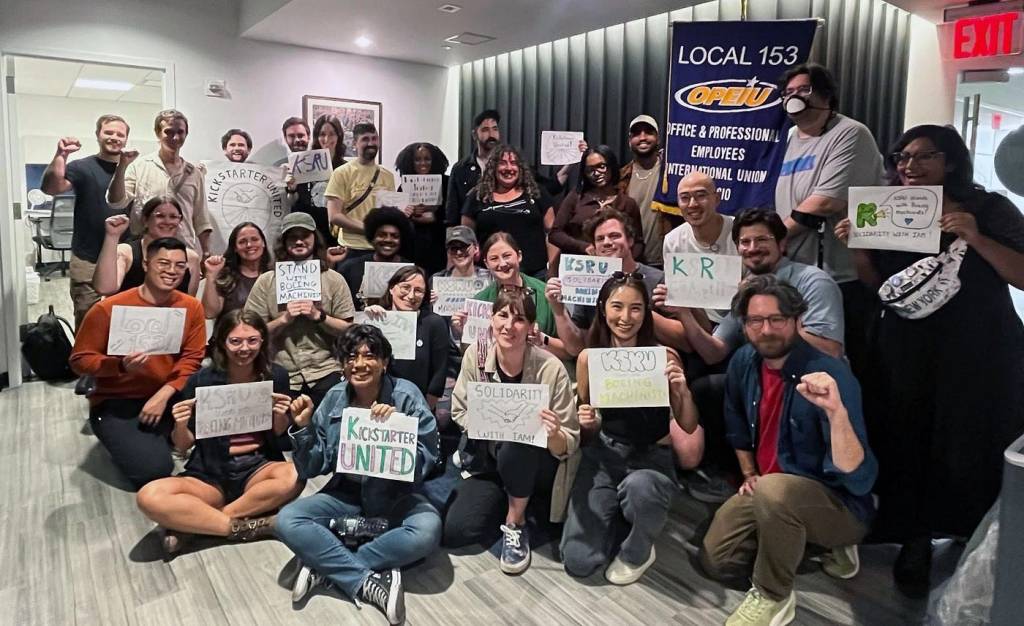
Staff Engineer Janel diBiccari was locked out of the Kickstarter employee portal. Her colleagues were also locked out. It was a small effect of being on strike.
Founded in Greenpoint, Brooklyn in April 2009, Kickstarter is a virtual crowdfunding platform that allows individuals and businesses to fund their projects and programs. Categories covered include design, comics, film, food, music, and many others. Across all categories, Kickstarter has raised over $9 billion. Rival crowdfunding sites include GoFundMe and Indiegogo. Following the COVID-19 pandemic, Kickstarter laid off a large number of employees before transitioning from in-person to fully remote work. To combat these issues, remaining workers formed a union, Kickstarter United (KSRU), becoming the first major tech company in the country to unionize. In July 2022, its first collective bargaining agreement went into effect. It expired in July 2025, and Kickstarter workers went on strike three months later after failing to come to terms on a second collective bargaining agreement.
“I’m scared that they just want to keep grabbing onto power for no reason and keep us out on strike more than they should,” said Senior Software Engineer and KSRU member Dannel Jurado. “We live in—unfortunately—very, very dark times.”
Management rejected every proposal, with an emphasis on returning to a 40-hour, 5-day workweek.
According to their official website, Kickstarter prides itself on creating an environment where employees’ lives are valued outside of the workplace. But employees don’t feel that this is the case. They are fighting for a fair contract. They’re asking for a 32-hour, 4-day workweek to be protected and codified and a minimum base salary of $85,000, primarily for their lowest-paid employees.
The Kickstarter strike was first announced on Thursday, October 2 and entered its second week last Friday. On Oct. 7, KSRU members rallied and picketed outside of Union Square Venture, home to company board member and venture capitalist Fred Wilson. The rally lasted two hours. Over forty Local 153 members from KSRU and other unions gathered again last Tuesday. Some said they drove down from Vermont, Pennsylvania and New Jersey.
“It’s weird to wake up and not be able to do your job,” said diBiccari. “But it’s been very empowering to have a plan and have a schedule that allows me to collaborate with people across the organization in a way that I don’t normally get to do.”
Rather than going into the office during the week, workers have the luxury of working remotely. Despite working remotely, employees say, the job is demanding, isolating and mentally draining. Many Kickstarter workers said that the strike is one of the first times they’ve interacted with all their colleagues. “This is important for mental health post-pandemic,” said Nick Galipeau, Secretary-Treasurer and Executive Director of OPEIU Local 153.
The official Kickstarter website says, “Our mission is to help bring creative projects to life.”
Its current “featured project”—Echizen-Wakasa Kidan: Strange Tales from Fukui by Japan-based artist Matthew Meyer—is a collection of “illustrated stories of yokai, ghosts and weird tales from rural Japan.”
Kickstarter currently has 287,029 successfully funded projects, all with various amounts of money raised ranging from less than $1,000 to $1 million. The bulk of successful Kickstarter projects (150,697) raised between $1,000 and $9,999.
Kickstarter didn’t respond to a request for comment by deadline.
According to Levels.fyi, the median salary for software engineers in New York City is between $185,000 and $208,000. At Kickstarter, Galipeau said that there are coders being paid under $75,000, falling below the 25th percentile.
As of this year, the New York City government stated that for a family size of one, low-income—51-80% of area median income—was between $56,700 and $90,720. In New York City, employees can make $90,000 and still be low-income.
It is uncommon for people working in technology to unionize, making this strike especially unique. Within the last year, the New York Times Tech Guild—another tech-heavy union—has also gone on strike. Other unions representing tech workers include the Campaign to Organize Digital Employees and the Alphabet Workers Union.
This was originally created as part of a class assignment for Reporting at the Columbia University Graduate School of Journalism.
 Destiny Rae Jones