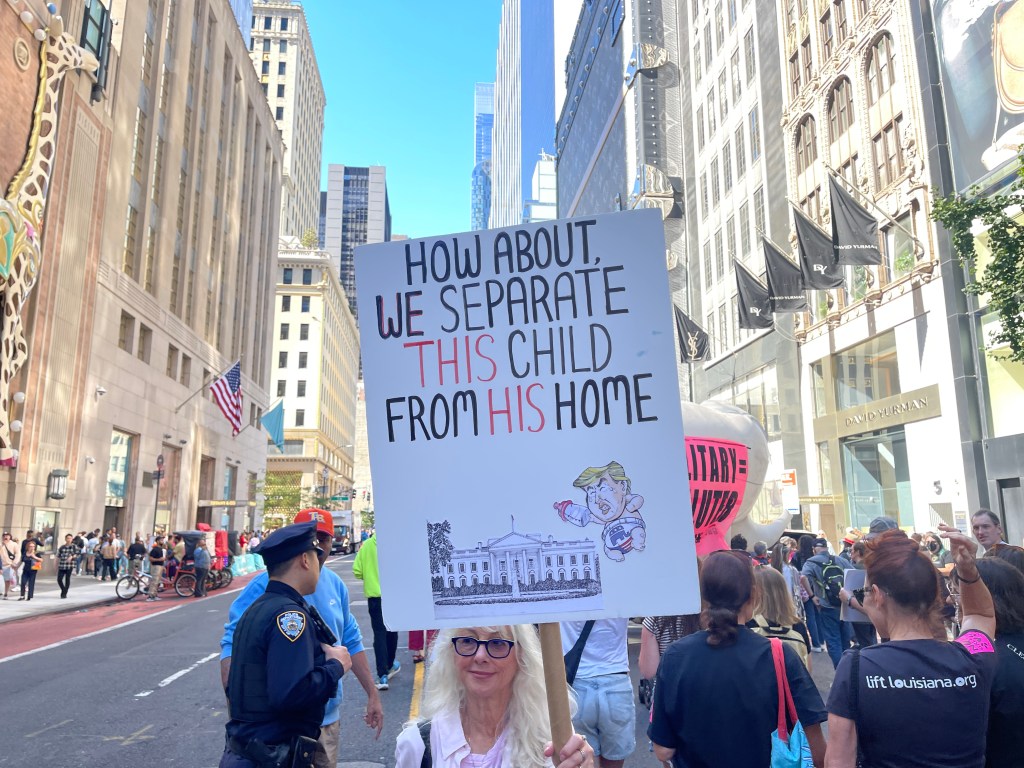
On Saturday, tens of thousands of people attended the Make Billionaires Pay March in Manhattan. The march started on Park Avenue and ended at Columbus Circle with protesters making stops at four locations: Blackstone, Trump Tower, Billionaires’ Row, and Trump International Tower.
This marked the first time that this march was organized, an event that coincided with Climate Week and the United Nations General Assembly (UNGA). Climate Week began in 2009 and has occurred every September since. This year, it’ll take place from September 21 to 28. The UNGA is four days long, with the conclusion of the assembly being September 29.
“To amass enough wealth to experience riches for ten thousand lifetimes and never finish using all of your resources—at the expense of other people, at the expense of the planet, at the expense of future generations—to me, is fundamentally anti-human,” said Jawanza Williams, a Make Billionaires Pay march organizer and a political science PhD candidate at the CUNY Graduate Center.
Many protesters from the Make Billionaires Pay March will also be present at Climate Week events. They gathered in support of different movements with the majority aiming to shut down billionaires, fascists, and polluters, with a heavy focus on class and socioeconomic status.
“The billionaire class are threatening all organized life with annihilation,” said Williams.
An overwhelming number of people cited President Donald Trump and other billionaires as the main people contributing to class imbalance. According to Coalition for the Homeless, over 350,000 people are homeless as of this month. “You have to ultimately talk about people building a movement that’s gonna do right with the system. That’s international, that’s multiracial, that’s multi-issue, that understands the basic problems,” said the editor of Multiracial Unity Blog and march attendee, Ellen Isaacs.
In 2023, there were 1.73 million people residing in New York City who received Supplemental Nutrition Assistance Program (SNAP) benefits. SNAP, widely known as food stamps, allows low-income individuals and families to purchase food at select stores.
“It’s the most unequal time in this nation’s history,” said Shailly Gupta Barnes, Policy Director of the Kairos Center for Religious, Rights, and Social Justice, an organization that strives to end poverty.
This was originally created as part of a class assignment for Reporting at the Columbia University Graduate School of Journalism.
 Destiny Rae Jones