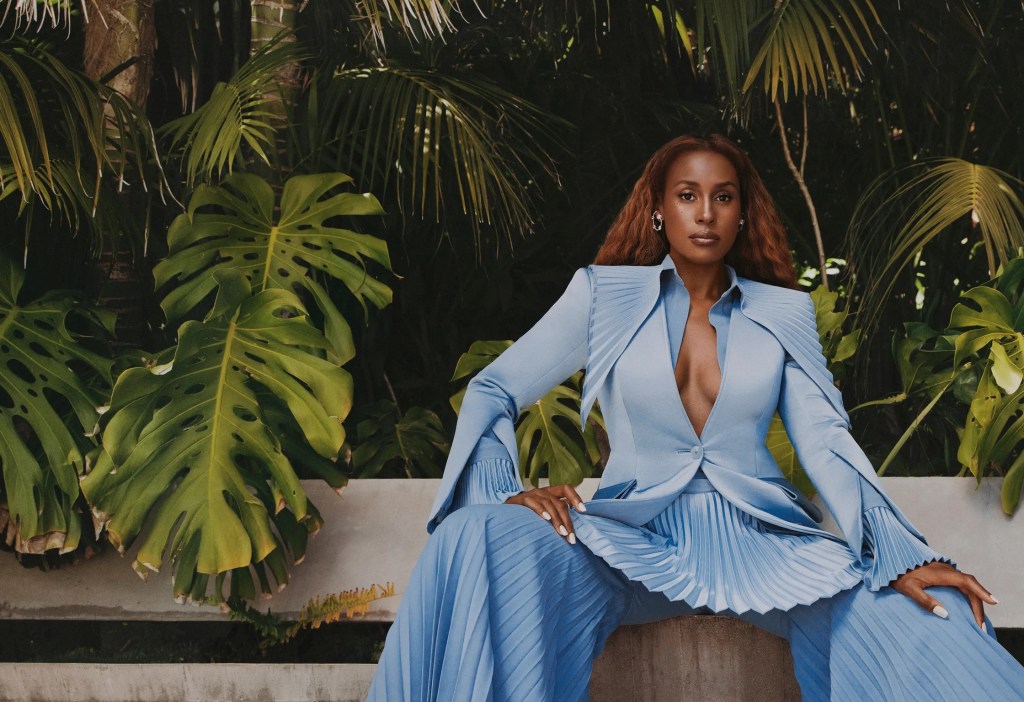
Actress, writer, and producer Issa Rae captures the unique experiences and complexities of Black womanhood, allowing viewers to connect not only with her characters but also with her as an individual. To better understand Issa Rae’s star image, it is important to consider these four aspects: her career, her web series The Misadventures of Awkward Black Girl (2011), contributing discourses and values, and her humor and lightheartedness.
Issa Rae’s career, specifically the type of media she has appeared in, is the first step to better understanding her star image. She is mostly known for her work in the television series Insecure (2016-2021) and the film Little (2019). Although she is mainly known for her acting, she also has a career in screenwriting and producing films and television shows: Rap Sh!t (2022), the Lovebirds (2020), and The Photograph (2020) (Issa Rae, n.d.). The genres, character types, medium, and range are typically similar when looking at her various media. All the above media texts are categorized as comedies or dramedies. The Photograph (2020), however, is primarily a drama film, offering viewers a representation that is atypical of Issa Rae. Her character types are almost always identical, typically playing the likable and relatable protagonist. Likewise, her characters are dynamic—people who experience positive change and development throughout the story. Similar to playing in dramedies, she portrays a character that is usually there for comic relief and to ease tension between characters. Issa Rae’s notable works are mainly in film and television aside from The Misadventures of Awkward Black Girl (2011), all of which she either acted in, wrote, and/or produced.
In arguably her most significant work, The Misadventures of Awkward Black Girl (2011), Issa Rae’s character, J, is characteristic of her star image: awkward and relatable. The very title of her web series, The Misadventures of Awkward Black Girl (2011), emphasizes this eccentricity that the main protagonist, J, possesses. In almost every instance, she finds herself in uncomfortable, awkward situations. In season one, episode three, “The Hallway”, J declines a call from a desperate man who continuously tries to flirt with her despite her repeatedly turning him down. However, J fails to realize that the man is standing right behind her, hearing her say, “ignore,” before declining his call (Rae, 2011, 1:04-2:07). Although the interaction is awkward and hard to watch, almost all of us have been in this exact position. Sometimes, we do not want to talk to or be bothered with someone, so we actively avoid them or make up a pathetic excuse. In season one, episode two, after J changes her hairstyle, her boss badgers her with questions like “Do you wash it? Can you wash it? Is that how your ancestors wore it?” (Rae, 2011, 0:05-0:29). It is common for non-Black people to negatively comment on Black people’s, specifically Black women’s, hair and appearance as a whole. Their apparent curiosity comes across as both ignorant and rude. Unfortunately, this is a universal experience for most—if not all—Black women in society. I can easily recall the countless instances where non-Black people have touched my hair unprompted.
Issa Rae’s star image is shaped by her encouragement and advocacy for Black representation in the media as well as her emphasis on the challenges and experiences of Black women. At the 2017 Emmy Awards, when an interviewer asked her who she was rooting for, Issa Rae replied, “I’m rooting for everybody Black…betting on Black tonight,”. Her comment immediately made me smile because of her genuineness. Oftentimes, Black creators feel the need to compromise their authentic selves for the sake of their environment or the people they are interacting with. In a red carpet interview, Issa Rae exclaimed that she was rooting for those that looked like her: ”everybody Black”. As a minority interested in creative media, I have noticed how difficult it is for people of color—in this case, Black people—to have their work showcased and to even be invited to such a popular award show. Therefore, it was extremely refreshing to see and hear Issa Rae actively support Black creators and encourage Black representation in film and television. The second discourse that shaped Issa Rae’s star image is her continuous emphasis on the unique experiences of Black women. Her works are mainly centered around the protagonist’s journey of learning how to navigate overthinking and wrestling with both platonic and romantic relationships. This is especially true in Insecure (2016-2021) where her character, Issa Dee, is unapologetically herself, never compromising her authenticity for the sake of others. She tries to figure out what types of people and relationships she not only wants but needs in her life. In doing so, she often uses humor to break tension and build these relationships. There also tends to be a theme of finding oneself while balancing one’s career, social life, and personal life.
In both media texts and her personal life, Issa Rae’s star image can be described as humorous and lighthearted in nature. However, there are some characteristics that are specific to the characters she plays in the media. Her characters tend to be awkward and quirky, but also raw and genuine. When browsing through her social media, specifically her Instagram page, I noticed that she has no posts featuring her husband, emphasizing her intentionality in keeping her personal and love life private (Rae, n.d.). Her relatability is apparent through the type of content she posts on her social media—content that showcases her personality and sense of humor.
In conclusion, Issa Rae’s star image reflects the uniqueness of Black womanhood through her career, humor, lightheartedness, and discourses and values. Her ability to write and represent this journey through Black womanhood, especially in The Misadventures of Awkward Black Girl (2011), has allowed her to connect with viewers on a more personal level. Issa Rae’s intentional depiction of the Black experience in the media further contributes to her influence as an actress, writer, and producer.
References
Issa Rae. (n.d.). IMDb. Retrieved October 3, 2024, from https://www.imdb.com/name/nm4793987/
Rae, I. [@issarae]. (n.d.) Posts [Instagram profile]. Instagram. Retrieved October 2, 2024, from https://www.instagram.com/issarae/
Rae, I. (Writer & Director). (2011). The Hallway [Television series episode]. In Rae, I (Producer), The Misadventures of Awkward Black Girl. Los Angeles, CA: Hoorae Media.
Rae, I. (Writer & Director). (2011). The Job [Television series episode]. In Rae, I (Producer), The Misadventures of Awkward Black Girl. Los Angeles, CA: Hoorae Media.
This was originally created as part of a class assignment for Capstone Topics: Celebrities of Color at the University of Virginia.
 Destiny Rae Jones