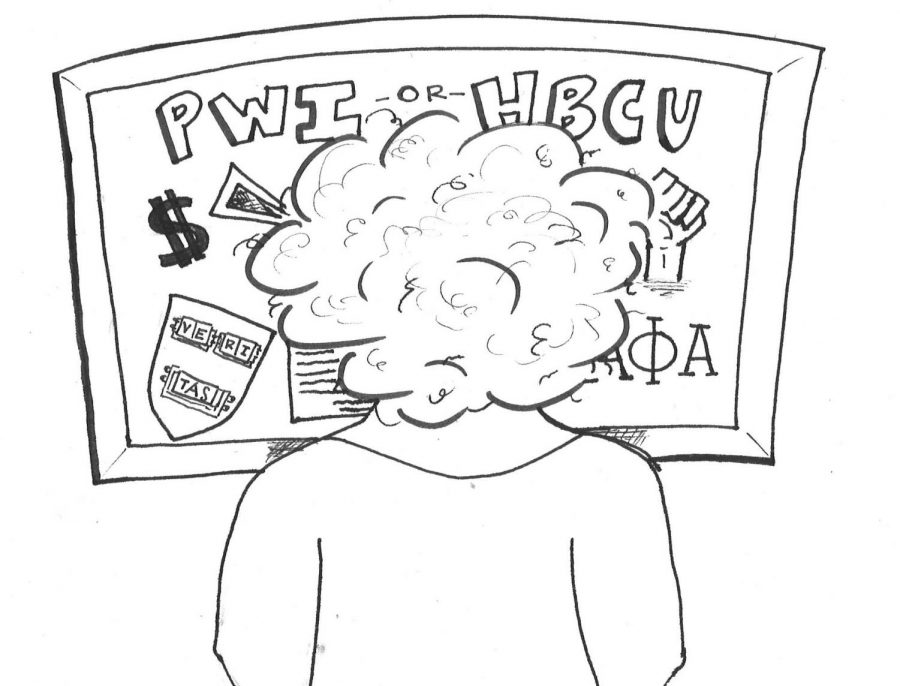
Historically Black colleges and universities (HBCUs) and predominantly White institutions (PWIs) both offer students with a unique experience and rich history. Typically, Black students attend HBCUs, and White students attend PWIs. In some cases however, Black students attend PWIs for a number of reasons such as greater funding, a more rigorous workload, or more academic and extracurricular opportunities. As a Black woman attending a PWI, I am curious about the experiences of other Black women. I am particularly interested in how environmental factors influence the experiences of Black female undergraduate students. Therefore, I wanted to explore if and/or how attending a HBCU versus a PWI affects Black female undergraduate students. There are various social and environmental influences that affect many areas of their lives including their social development, academic growth, and sense of self. So, my research question explores the above topics: How are experiences and outcomes different at historically Black colleges or universities versus predominantly White institutions for Black female undergraduate students? First, I will review five empirical articles discussing various aspects of Black female identities, then I will describe similarities, differences, and limitations of each.
Neal-Jackson (2020) delved into how Black women experience stereotype threat in collaborative academic spaces at predominantly White institutions. Stereotype threat refers to the “socio-psychological threat felt by an individual during a situation or activity for which a negative stereotype applies to a group which they belong to and identify with meaningfully” (Neal-Jackson, 2020). In this study, researchers used a qualitative research design based on 30 interviews. The interviews were scheduled to last 60 minutes but the average interview time was 90 minutes, showing that Black women were both engaged and fascinated. This data was analyzed using a thematic analysis approach by examining relationships between the codes as well as grouping their experiences into larger categories (Neal-Jackson, 2020).
Interestingly, Neal-Jackson (2020) found that Black women were able to weaken some of the negative influences of stereotype threat. She explained that “Black women’s awareness of and struggle with how they were seen by their White peers highlighted their double consciousness” (Neal-Jackson, 2020). Double consciousness refers to “Black people’s experience of having to contend with how they see themselves and how they understand that world to see them” (Neal-Jackson, 2020). This hyperawareness allowed Black women to recognize instances in which stereotype threat could occur, making them less susceptible to it. Not all Black women experience the same things, so this combativeness varies based on the individual as well as their environment. One approach to address this is by creating more welcoming and inclusive academic environments for not only Black women but all minority groups.
Additionally, Donovan and West (2015) investigated how the “Strong Black Woman” stereotype impacts Black women’s stress and mental health. The Strong Black Woman” (SBW) stereotype refers to “a perception that Black women are naturally strong, resilient, self-contained, and self-sacrificing” (Donovan & West 2015). In this study, researchers used a cross-sectional survey design to examine how the SBW stereotype affects stress and mental health. They recruited Black women at least 18 years old by using social media and advertisements geared toward them. The sample consisted of 92 participants between the ages of 18 and 47. Participants identified themselves as a few different categories: African American (41%), West Indian/Caribbean (18%), Other (17%), African or Cape Verdean (15%), Multiracial/Biracial (7%), and Hispanic Black (3%) (Donovan & West 2015). Researchers analyzed the survey responses using multiple regression.
Donovan and West (2015) concluded that the Strong Black Woman stereotype could be both advantageous and disadvantageous. Benefits of the SBW stereotype include being resilient, self-contained, and self-sacrificing (Donovan & West 2015). However, it also promotes the idea that Black women must exemplify these traits at all times. According to the SBW stereotype, Black women should not be sensitive or compassionate; they must be strong, independent, and stable. Stereotypically SBW self-reported higher levels of stress and lower levels of well-being. Additionally, “Black female college students who endorse SBW might have difficulty admitting they need therapy, much less seek it” (Donovan & West 2015). Rejection of and reluctance to seek therapy and counseling is extremely common among the Black community, so these findings are unsurprising. Interestingly, however, researchers found that the correlation between SBW and stress was significant yet weak (Donovan & West 2015). Similarly, they found no significant correlation between SBW and depressive symptoms and SBW and anxious symptoms, showing that SBW alone does not have a direct influence on depression and anxiety (Donovan & West 2015). One way to combat effects of the Strong Black Woman stereotype is with greater diversity and representation of Black women. Acknowledging and understanding that Black women have a wide range of traits, characteristics, and personalities is the first step to encourage better stress and mental health outcomes.
Stitt and Happel-Parkins (2019) examined the shared experiences of Black female engineering students at predominantly White institutions. Engineering is a stereotypically masculine field that is primarily dominated by White men. Therefore, it is common for many Black women to experience racism, sexism, and prejudice. This study is an example of a qualitative research study. Researchers conducted interviews with nine undergraduate Black women in engineering programs at PWIs (Stitt & Happel-Parkins, 2019). This study also used a thematic analysis approach since researchers aimed to point out themes, similarities, and differences among Black female engineering students.
Results from Stitt and Happel-Perkins (2019) showed that Black female engineering students face challenges that negatively impact their well-being and academic performance. There were two main themes present from the initial interviews that researchers conducted: “challenging stereotypes by doing something out of the ordinary and persisting for future generations despite adversity” (Stitt & Happel-Perkins, 2019). Theme one emphasized how society views Black women in engineering while theme two emphasized how they view themselves. Many Black women are often overlooked and silenced in academic settings. This is especially true when these women attend PWIs and when they choose nontraditional careers such as engineering. This leads to feelings of isolation, doubt, and incompetent. One way to improve experiences faced my Black female engineering students is by taking an intersectional approach to consider Black women’s race and gender (Stitt & Happel-Perkins, 2019). This means that one must understand that the challenges and experiences of Black female engineering students are different from Black male engineering students as well as White female engineering students. Another way is by encouraging mentorship among current Black female engineers and young girls aspiring to become engineers. Doing this would facilitate a more welcoming and diverse environment for students to learn, grow, and develop.
Furthermore, Lockhart (2019) explored how the process of writing memoirs promotes mutual vulnerability and intergenerational healing for Black women attending historically Black colleges and universities. Mutual vulnerability and intergenerational healing are two terms that one must know to fully understand Lockhart’s research study. Mutual vulnerability is the sharing of intimate details and focuses on reducing or eliminating discomfort surrounding the sharing (Lockhart, 2019). In this study, the goal of mutual vulnerability is to help create a sense of belongingness and community among Black women at HBCUs. In addition, participants practiced intergenerational healing through the process of personal plot (Lockhart, 2019). Rather than focusing solely on their challenges, hardships, and traumas, they identified the positive outcome from their experiences. Doing this allowed the participants to be grateful for some aspects of their hardships, thus making them more likely to help others who have endured similar situations in the future. This study is an example of a qualitative study that uses narrative inquiry (Lockhart, 2019). Researchers described one compelling example: “In the interviews, the eldest participant Yolanda stated that she repurposed her previous obstacle and negative behavior of seeking attention into stage presence that would help her deliver poetic and musical messages of survival to young girls” (Lockhart, 2019). This study focused primarily on personal narratives, anecdotes, and testimonials through interviews, focus groups, and memoirs.
Results indicated that both mutual vulnerability and intergenerational healing help Black women feel welcomed, connected, and accepted. Memoir writing played a significant role in facilitating and increasing intergenerational healing. Researchers found that sharing personal stories created greater community among Black women and helped them heal as well as process their emotions. Like Yolanda, other women also shared their personal stories and emphasized a desire to help younger Black women and girls. This study is particularly interesting because researchers interviewed Black women at HBCUs where there is already a strong presence of community. Still, they were able to bond further through their similar experiences of oppression and discrimination.
In order to understand the varied experiences of Black female undergraduate students, we must first consider how social and environmental factors have impacted Black college women’s behaviors and actions. Chandler et al. (2021) explored whether social and environmental factors influenced the sexual behaviors of Black college women. Researchers used a descriptive cross-sectional survey design in this study. They distributed online surveys that measured six distinct variables: sociodemographic status, sexual history and experience, HIV knowledge, motivation, behavioral skills, and musical influence (Chandler et al. 2021). These surveys were given to Black college women at both HBCUs and PWIs to measure environmental influence. Then, researchers evaluated two of the six categories through various measures. For example, motivation was assessed through four measures: perceived normals, condom attitude, behavioral intentions, and future time perspectives (Chandler et al. 2021). Additionally, behaviors skills were split into two measures: condom use and other contraceptives (Chandler et al. 2021). Evaluating through measures allowed investigators to simplify their variables and make them more identifiable and explicit.
Although Chandler et al. (2021) looked at six variables, only a few were statistically significant. Comparing both Black college women attending HBCUs and PWIs, there were no significant differences in HIV knowledge, condom attitudes, behavior intentions, and social norms (Chandler et al. 2021). On the other hand, both sexual experience and musical influence were statistically significant. They found that various socio-cultural factors had a much stronger impact on Black college women attending an HBCU as opposed to a PWI (Chandler et al. 2021). These socio-cultural factors included music (rap, hip-hop, and R&B) and media (Black pride, sexual normativity, and traditional gender roles). This may be a result of the high presence of Blackness and Black culture at HBCU, which includes rap and hip-hop music and culture as well. Researchers acknowledged that rap and hip-hop music alone do not directly influence Black college women’s behaviors and actions. However, the ideologies that it emphasizes can consciously and subconsciously influence the way Black college women speak, think, and behave. Researchers explained that “the content of hip-hop and rap music may promote certain misogynistic expressions that may affect gender relations… result in Black women conforming to certain social pressures… partaking in risky sexual behavior thus increasing their risk for STIs and HIV (Chandler et al. 2021). Interestingly, Black women at PWIs self-reported more risk-taking behaviors compared to their counterparts at HBCUs (Chandler et al. 2021). Sexual risk-taking behaviors include engagement in unprotected sex and having more than one sexual partner. The best way to combat these findings is by taking a culturally relevant approach to sexual health education programs. That way, Black women at PWIs can be more knowledgeable about safe sex practices with consideration to their race, ethnicity, or cultural background. Ultimately, these findings showed that social and environmental factors (e.g. attending a HBCU versus a PWI) affect Black women’s sexual behaviors.
After analyzing all five research studies, I noticed several similarities and differences. Three studies utilized qualitative research designs, and two studies utilized cross-sectional survey designs. Researchers who used qualitative methods focused on conducting and analyzing interviews. On the other hand, researchers who used cross-sectional methods collected their data via survey responses. There was one interesting similarity in the results of Neal-Jackson (2020) and Stitt and Happel-Parkins (2019). Both researchers concluded that stereotype threat plays a significant role in the mental health of Black female undergraduate students. Neal-Jackson (2020) studied how stereotype threat operates in academic spaces at PWIs. Similarly, Stitt and Happel-Parkins (2019) discussed how stereotype threat elicits negative emotions and feelings in Black female engineering students. Parallels can be drawn between these two studies since both discussed the effects of stereotype threat on Black college women attending PWIs. Additionally, Stitt and Happel-Parkins (2019) also has similarities with Lockhart (2019) since both studies emphasized the importance of community and facilitating a sense of belonging. Black women thrive in environments where they feel welcomed and appreciated. These aspects positively influence their thoughts, feelings, and behaviors in various environments. In general, Black female undergraduate students face unique challenges at HBCUs and PWIs. This analysis has shown that social and environmental factors must be considered and examined in order to fully understand the advantages and disadvantages of Black women attending either historically Black colleges and universities versus predominantly White institutions.
References
Chandler, R., Guillaume, D., Tesema, N., Paul, S., Ross, H., & Hernandez, N. D. (2021). Social and environmental influences on sexual behaviors of college Black women: Within group diversity between HBCU vs PWI experiences. Journal of Racial and Ethnic Health Disparities, 8(4), 852–862. https://doi.org/10.1007/s40615-020-00843-2
Donovan, R. A., & West, L. M. (2015). Stress and mental health: Moderating role of the strong black woman stereotype. Journal of Black Psychology, 41(4), 384–396. https://doi.org/10.1177/0095798414543014
Lockhart, Z. (2019). Mutual vulnerability and intergenerational healing: Black women HBCU students writing memoir. Journal of Poetry Therapy, 32(3), 169–180. https://doi.org/10.1080/08893675.2019.1625156
Neal-Jackson, A. (2020). “Well, what did you expect?”: Black women facing stereotype threat in collaborative academic spaces at a predominantly White institution. Journal of College Student Development, 61(3), 317–332. https://doi.org/10.1353/csd.2020.0030
Stitt, R. L., & Happel-Parkins, A. (2019). “Sounds like something a White man should be doing”: The shared experiences of Black women engineering students. Journal of Negro Education, 88(1), 62–74. https://www.jstor.org/stable/pdf/10.7709/jnegroeducation.88.1.0062.pdf?refreqid=excelsior%3Ac473cf36fb9b89e39860b6fb76d93469&ab_segments=&origin=&initiator=&acceptTC=1
This was originally created as part of a class assignment for Introduction to Educational Psychology at the University of Virginia.
 Destiny Rae Jones